






- Why Is Porcelain Stoneware the Industry Standard for Fireplace Surrounds?
- What Should You Know About the Heat Resistance and Maintenance of Natural Stone?
- Why Is Adhesive Engineering Critical for Fireplace Tile Installation?
- Why Is Standard Drywall Unsuitable for Fireplace Surrounds?
- Which Technical Ratings Matter Most for a Safe and Durable Hearth?
- How Does Tile Origin and Production Quality Impact Fireplace Performance?
- What Makes Fireplace Tile Installation in Denver Especially Challenging?
In the world of architectural ceramics, a fireplace is far more than a visual anchor; it is a complex assembly that must withstand extreme thermal cycling. As a senior copywriter with over a decade of hands-on experience in the ceramic industry—from the kilns of Sassuolo to luxury residences in the Rockies—I have seen how technical oversight can turn a masterpiece into a structural liability.
The Denver market, characterized by its dry air and rapid temperature shifts, requires a specific engineering approach. Whether you are a homeowner, a designer, or a developer, understanding the material science behind the hearth is non-negotiable. If you treat a fireplace surround like a kitchen backsplash, you are begging for a failure. I have seen $20,000 installations compromised because a contractor used a standard mastic that couldn’t handle the BTU output of a modern linear gas insert. In the Colorado climate, where a living room can swing from 65°F to a localized 150°F near the glass in minutes, material science is your only insurance policy.
1. The Physics of the Surround: Why Porcelain Stoneware is the Industry Standard
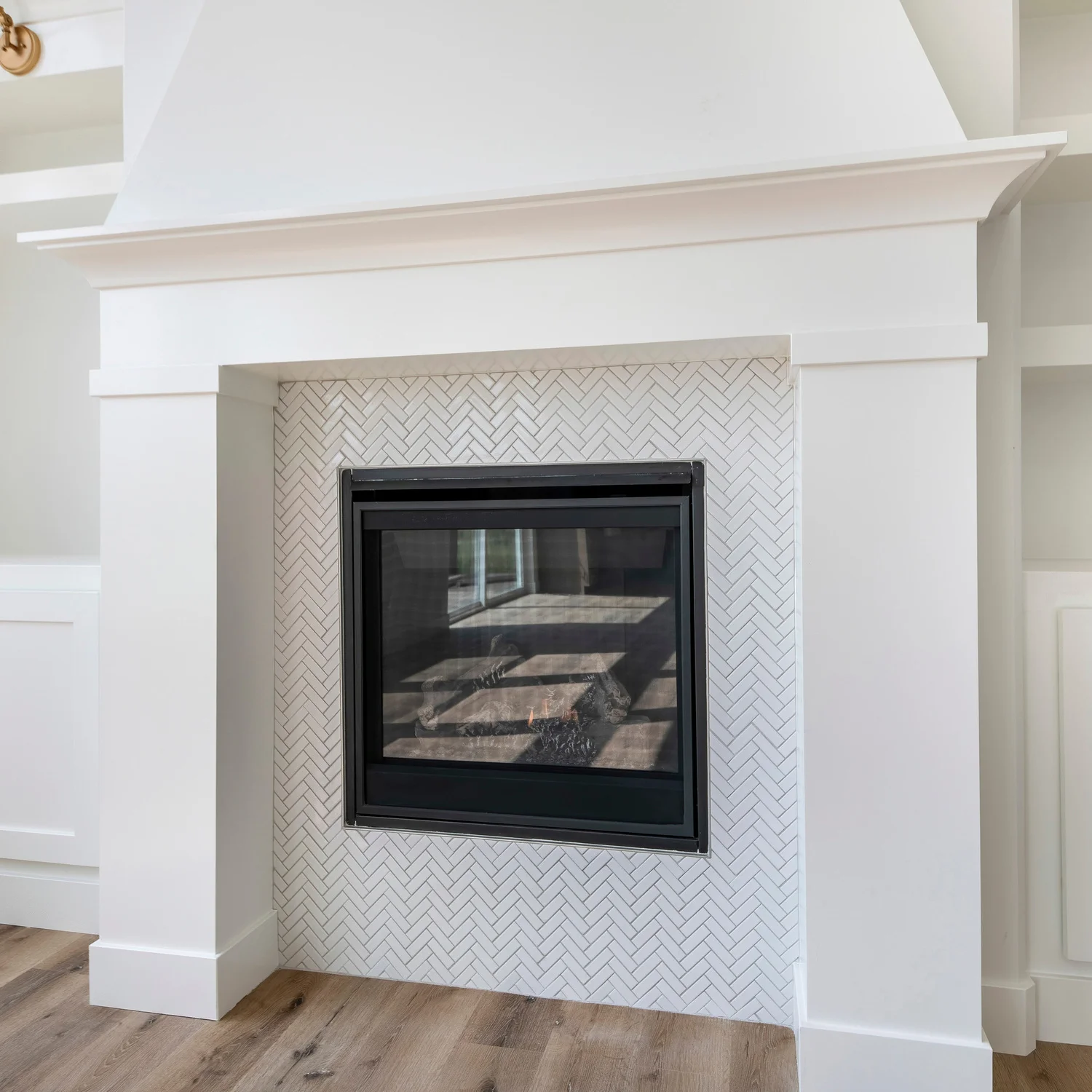
In the professional trade, we distinguish sharply between standard ceramics and porcelain stoneware (gres porcellanato). For any area subjected to direct heat radiation, porcelain is the only logical choice due to its manufacturing process. Fired at temperatures between 1200°C and 1400°C, porcelain undergoes full vitrification, resulting in a water absorption rate of less than 0.5%.
This density is the foundation of thermal stability. A high-density porcelain body acts as an effective heat sink, dissipating thermal energy without the microscopic structural fatigue that causes lower-grade ceramic tiles to crack or “shiver” their glazes. When we talk about “thermal shock resistance,” we are referring to the tile’s ability to endure rapid temperature changes without cracking. Porcelain excels here because its mineral composition is fused so tightly that there is almost no room for internal moisture to expand or for air pockets to create stress points.
The Rise of Large Format Slabs and Sintered Stone
Modern trends have moved toward 6mm and 12mm gauged porcelain panels, often marketed as sintered stone. These slabs, reaching sizes up to 1600mm x 3200mm, offer a monolithic, “slab” look previously only possible with natural stone. However, they come with a higher degree of internal tension.
An expert fireplace tile installation using these slabs requires specialized vacuum-frame handling and precise diamond-abrasive wet-cutting. If you are searching for a tile installer near me to handle these massive formats, you must ensure they are trained in GPT (Gauged Porcelain Tile) standards. Without the right equipment, the tension in these slabs can lead to catastrophic fracture during the first few heating cycles of the fireplace. Furthermore, the handling of these slabs is a logistical puzzle. If a slab is flexed too far during the carry from the truck to the living room, microscopic fractures can form, only to reveal themselves as full-blown cracks once the fireplace heat causes the material to expand.
2. Natural Stone Realities: Heat Resistance vs. Maintenance
Natural stone remains the pinnacle of luxury, but it requires a deep understanding of mineralogy. Unlike factory-controlled porcelain, natural stone has inherent “defects”—veins, fissures, and mineral pockets—that react differently to heat. In a high-end residential tile installation Denver project, the choice of stone can dictate the maintenance schedule for years to come.
- Granite and Quartzite: These are the workhorses of the natural world. With high thermal conductivity and a tightly interlocked crystalline structure, they handle heat with minimal expansion stress. Quartzite, in particular, has become a favorite for its marble-like appearance and granite-like durability.
- Marble: While aesthetically unmatched, marble is calcium-carbonate-based. In wood-burning applications, the acidic nature of soot can etch the surface of polished marble. Heat can also accelerate “iron staining” if moisture was trapped during installation, causing a beautiful white slab to develop unsightly yellow or brown patches near the firebox.
- Limestone and Travertine: These sedimentary stones are beautiful but notoriously porous. Heat can cause moisture within the stone to vaporize, leading to “spalling,” where the face of the stone literally flakes off. If you choose limestone, it must be a high-density variety, and it must be sealed with a high-performance, heat-stable impregnator.
Achieving 100% mortar coverage via “back-buttering” is critical for stone. Air gaps behind the stone act as insulators, creating localized “hot spots” that stress the material until it cracks. This is especially true for stacked stone or “ledger” panels, where the uneven back of the stone makes consistent coverage difficult for inexperienced installers.
3. Engineering the Bond: The “Invisible” Science of Adhesives
The most common failure in fireplace tiling isn’t the material; it is the chemistry of the bond. Standard mastic or low-grade thin-sets become brittle when exposed to the 100°C+ temperatures found near a fireplace opening. As a veteran in the industry, I have seen tiles simply fall off the wall because the adhesive was “cooked” over two seasons of winter use.
Specifying C2S1 and C2S2 Standards
At Kris Tile Service Denver, we strictly follow ISO 13007 classifications for all heat-exposed surfaces. We utilize C2S1 or C2S2 high-polymer, cementitious adhesives.
- C2 indicates high bond strength (at least 1 MPa).
- S1 (Deformable) and S2 (Highly Deformable) are the most critical ratings for fireplace work.
A fireplace surround is a moving system. It expands when the fire is lit and contracts when it cools. An S1 or S2 rated adhesive has the polymer modification necessary to act as a shock absorber, absorbing the shear stress between the rigid tile and the expanding substrate. Without this “flex,” the tile will eventually de-bond or “tent.” Furthermore, the “open time” of the adhesive—how long it stays workable on the wall—is affected by the heat of the room. In Denver’s dry climate, a premium adhesive is required to ensure the bond doesn’t “skin over” before the tile is set.
4. Substrate Preparation: Why Drywall is the Enemy of Longevity
One of the greatest industry fallacies is that you can tile a fireplace surround directly over standard gypsum drywall. In a high-heat zone, this is a violation of both physics and common sense. If your contractor tells you it’s “fine,” they are likely not an industry specialist.
The Material Transition and Dehydration
Standard drywall has a paper facing—a combustible material. Furthermore, the gypsum core dehydrates at temperatures above 122°F (50°C), losing its structural integrity and turning to powder. This leads to a total bond failure where the tile doesn’t just crack; it peels away with the paper and crumbled gypsum attached.
Instead, we utilize non-combustible cement backer boards or calcium silicate boards. These materials provide a rigid, heat-stable surface that matches the expansion coefficient of the tile more closely. For projects where the tile must transition to drywall in the rest of the room, we use specialized fiberglass mesh tape and polymer-modified mortar to bridge the joints. This prevents the “settling cracks” that plague amateur installations. We also account for the expansion joints. A large-format fireplace wall needs a perimeter movement joint at the ceiling and floor, usually filled with a color-matched 100% silicone sealant rather than hard grout, which would simply crack under the pressure of thermal expansion.
5. Technical Ratings for the Hearth: PEI and Slip Resistance
While the vertical surround is about heat, the hearth (the horizontal floor area in front of the fire) is about mechanical wear, load-bearing, and safety. This is where technical ratings like PEI and R-ratings become vital. A hearth is not just a landing pad for ash; it’s a functional part of the room’s flooring.
Decoding the Spec Sheet for Safety
Technical Term Requirement for Fireplace Hearths
- PEI Rating: You need at least a PEI III or IV. This ensures the glazed surface can withstand the weight of metal toolsets and wood baskets without scratching.
- Slip Rating (R9–R13): The hearth should have an R10 or R11 rating. Ash and soot can make polished surfaces incredibly slippery; a matte or textured finish provides the necessary traction.
- Rectification: Rectified edges are mechanically sawn to precise sizes. This allows for a 1/16″ grout joint, creating a clean, architectural look that minimizes the visual “grid.”
- Calibration Variance: Non-rectified tiles have slight size differences (calibration). These require wider grout joints to mask the discrepancy, which can be a trap for soot and ash.
In addition to these ratings, the hearth must be perfectly level. Because fireplaces are often the focal point of a room, any lippage (where one tile sits higher than the next) will be exaggerated by the light of the fire. Using a leveling system during installation is the only way to ensure a flat, safe surface for the hearth.
6. Global Market Insights: Quality Tiers and Distribution Dynamics
In my decade in the industry, I have seen how the global supply chain impacts the final result on your wall. Where your tile is made often dictates its bending strength, its rectification tolerances, and its aesthetic depth.
The Difference in Production
- Italian (Sassuolo): The vanguard of high-definition digital glazing. Their tiles don’t just look like stone; they have “depth” created by multiple layers of glaze and ink. Italian factories also have some of the strictest quality controls for “bowing” and “warpage,” which is crucial for large-format fireplace walls.
- Spanish (Castellón): Known for innovative textures and boutique metallic glazes. Spanish production is often the “sweet spot” for homeowners seeking high-end aesthetics with slightly more competitive pricing. They excel in reactive glazes that look stunning under the flickering light of a flame.
- Asian Production: While price-competitive, these tiles often suffer from inconsistent calibration. In a high-visibility area like a fireplace, a slight “bow” or “cup” in a cheap tile will create unsightly shadows (lippage) that no amount of grout can fix.
Margin Pressure and Private Labels
Many big-box retailers sell “private label” tiles that lack detailed technical spec sheets. For a fireplace, never buy a tile unless you can see its thermal expansion coefficient and water absorption rate. Saving $2 per square foot on the material is a poor trade-off for an installation that fails or looks “wavy” under the grazing light of a modern mantle.
7. The Denver Context: High-Altitude Tile Challenges and Solutions
Denver presents a unique environment for any residential tile installation Denver specialist. The combination of low humidity, high altitude, and intense UV light (if the fireplace is near windows) creates a challenging curing environment for mortars and grouts.
Atmospheric Impact on Curing
Mortars need moisture to hydrate and form the chemical crystals that create a bond. In Denver’s dry air, the water can evaporate out of the thin-set too quickly, leading to a “soft” cure. We often use specialized primers or “soak” porous substrates to ensure the moisture stays in the mortar where it belongs. Furthermore, our rapid temperature swings—from a 20°F morning to a 60°F afternoon—apply constant mechanical stress to a home’s structure. A fireplace tile job in Denver needs more than just a “guy with a trowel.” It needs a specialist who understands the interplay between local atmospheric conditions and thin-set chemistry.
At Kris Tile Service Denver, we don’t just “install” tile. We consult on the technical feasibility of your design to ensure that your fireplace is as safe and durable as it is beautiful. A fireplace is an investment in your home’s value and your family’s comfort—don’t let a generic installation compromise that. We take the time to inspect the fireplace unit, check the clearance-to-combustibles requirements, and ensure the entire assembly is built to last for decades, not just until the check clears.